
Cureday Erasmuskloof Talk
On May 13th, Cureday Erasmuskloof hosted an engaging presentation featuring Dr Jaco Naude and Dr Derik du Toit, two esteemed professionals in the medical field. The event attracted an audience of general practitioners and physiotherapists, eager to enhance their knowledge and skills.

Dr Naude and Dr. du Toit shared their expertise on innovative practices and the latest advancements in patient care, fostering an environment of learning and collaboration. This gathering not only provided valuable insights, but also strengthened the connections between various healthcare professionals dedicated to improving patient outcomes.
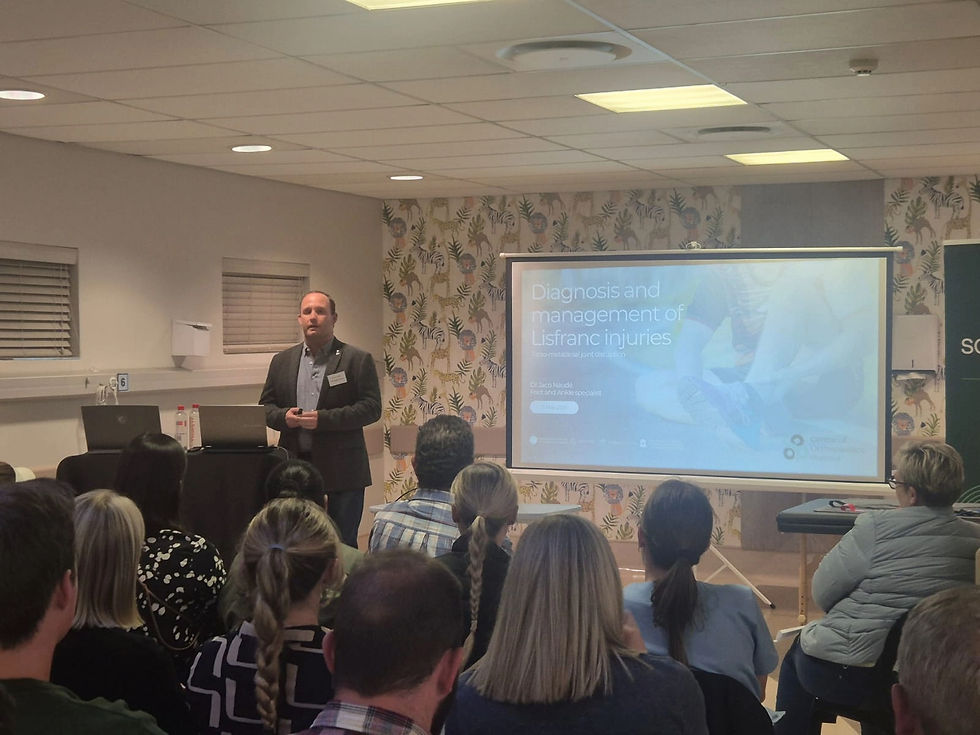
Dr Jaco Naude's presentation focused on Lisfranc joint injuries, covering anatomy, treatment options, and rehabilitation. This condition accounts for 0.2% of all fractures, often with unnoticed subtle injuries leading to chronic pain, and involves three articulations with the 2nd metatarsal as the keystone, supported by dorsal TMT, plantar TMT, and interosseous ligaments.
The diagnosis involves distinguishing between low-energy sports injuries and high-energy accidents, with signs including midfoot pain, difficulty bearing weight, and swelling. While imaging may reveal normal results in up to 50% of cases, making weight-bearing views and CT/MRI essential for accurate assessment.
In the management of injuries, emergency care involves immediate reduction and vascular checks; non-operative treatment is rarely suitable for stable, undisplaced injuries, while operative intervention is required for displaced injuries with options such as ORIF and arthrodesis. Both yield similar outcomes in individualized cases.
Key takeaways include the importance of maintaining a high index of suspicion for injuries that may be overlooked initially, ensuring weight-bearing radiographs are obtained and supplemented with CT or MRI as needed. Treatment should be individualised, with both ORIF and arthrodesis being viable options depending on the injury pattern. Successful outcomes hinge on anatomic reduction and stable fixation.

Dr Derik du Toit's presentation provided a practical framework for evaluating and managing acute ankle sprains, focusing on the anatomy of ankle ligaments. It highlighted that lateral ligaments (ATFL, CFL) are the most frequently injured, while medial and syndesmotic injuries are more serious. It underscored the necessity of a structured clinical assessment, including recognising red flags like inability to weight-bear and syndesmosis tenderness, along with the importance of delayed examinations for accuracy.
The presentation stressed the importance of early identification of serious injuries, appropriate rehabilitation, and setting realistic return-to-play expectations based on injury severity and treatment.
Key takeaway: Most ankle sprains heal well, but thorough assessment is crucial to avoid overlooking significant injuries that may need advanced imaging or surgery.


Comments